Chasing Losses, Spin Game
Chasing losses for spin game players in India, how it works, what it costs and how long it takes.
What is Chasing Losses?
Chasing losses is the behaviour of continuing to spin, or increasing your bet size, specifically to recover money you have already lost in a session. On a spin game like those at 777-spin.com, it looks like this: you start a session with ₹500, drop to ₹150, and instead of stopping you load another ₹500 via PhonePe or GPay and move to higher-stake spins to "win it back fast." That decision, driven by the need to recover, not by a planned strategy, is the defining mark of chasing.
It is distinct from normal extended play. The difference is intent and emotional state: a player who keeps spinning because they are enjoying the game is playing; a player who keeps spinning because they cannot accept the loss is chasing. The spin game outcome of any single round is determined by a certified RNG, meaning the reels have no memory of what you lost five minutes ago. Recovery is never owed to any player, regardless of how many consecutive losing spins have occurred.
In the Indian online gaming context, chasing losses is especially common after UPI top-ups because depositing is frictionless. With PhonePe or GPay, a ₹500 reload takes under 10 seconds, there is no queuing at a cashier, no ATM withdrawal, no physical wallet to empty. That speed removes the natural pause that once interrupted chasing behaviour, so the urge to re-deposit can be acted on before any rational evaluation takes place.
- Bet escalation: Moving from ₹10 spins to ₹50 or ₹100 spins mid-session to recover faster. For example, if you lost ₹200 on ₹10 spins, jumping to ₹50 spins feels like a shortcut to recouping, but it also means your remaining ₹150 bankroll lasts only three spins instead of fifteen.
- Re-deposit urgency: Topping up your balance immediately after busting, without a pause or review. Using BHIM or GPay UPI, this can happen in under 15 seconds, a dangerously short gap between the emotional low of busting and the act of putting more money at risk.
- Session extension: Telling yourself "just a few more spins" repeatedly past your planned stop point. Players who do this typically spend 2 to 4 times their original session budget before stopping.
- Justification thinking: Believing a win is "due" because you have lost several rounds in a row, for example, thinking that losing 12 spins in a row means the 13th must pay. This is the gambler's fallacy, and it has no mathematical basis on a certified RNG spin game.
Recognising these four signals in your own session is the first practical step to interrupting the cycle before it escalates into a larger financial loss. Being honest with yourself about which signal is present in the moment, escalation, urgency, extension, or justification, helps you apply the right corrective action from the steps covered later on this page.
Chasing Losses Safety and Timing
The safest window to act is the moment you notice the urge, not after you have placed the next bet. On any spin game session at 777-spin.com, use the following timing rules to stay in control. These rules are not general wellness advice; they are specific behavioural checkpoints calibrated to the pace of online spin gameplay.
Set a hard loss limit before you spin
Decide on a session loss ceiling in rupees before your first spin, for example ₹300 for a casual evening session, or ₹500 for a longer weekend session. Use the platform's responsible gaming tools to set this limit formally, not just as a mental note. A formal limit triggers automatically and removes the decision from an emotional moment. Compare this to a mental-note-only approach: research consistently shows that self-imposed mental limits are broken at a rate of over 60% once a loss threshold is crossed, whereas a platform-enforced limit holds regardless of emotional state.
The 5-minute rule after a significant loss
Any time your balance drops by 30% or more in a single session, step away from the screen for a minimum of five minutes. On a ₹500 starting balance, that threshold is a drop to ₹350 or below. This is not a suggestion, treat it as a mandatory cooling period. During those five minutes: put your phone face-down, drink a glass of water, and move to a different room if possible.
Do not open the app, do not calculate how much you need to win back, and do not check your balance. The physiological stress response (elevated cortisol and adrenaline) that drives chasing peaks within the first two to three minutes of a loss and measurably drops after a five-minute break.
When NOT to continue spinning
- You have already reloaded your balance once in the same session, whether via PhonePe, GPay, BHIM, net banking, or any other method. One re-deposit in a session is a hard stop signal.
- Your bet per spin has increased from your starting amount to compensate for losses. If you started at ₹10 per spin and are now at ₹25 or above, you have already escalated.
- You are tracking a running total of what you have lost rather than evaluating whether each spin is enjoyable. If the number ₹240 (or whatever your cumulative loss is) is in the front of your mind rather than the game itself, stop.
- It is past 11 PM and you are tired, fatigue sharply reduces the brain's ability to evaluate risk accurately, making chasing decisions far more likely at late hours than in the afternoon.
- You have just finished a stressful event, a difficult workday, an argument, financial news, and opened a spin game to unwind. Emotional stress is one of the strongest predictors of chasing behaviour because the brain conflates financial recovery with emotional relief.
Safe continuation signals
You can reasonably continue spinning if your balance is within your pre-set session budget, your bet size has not changed from your opening plan, and you would describe your motivation as entertainment rather than recovery. If all three conditions are true simultaneously, you are playing the spin game as intended, not chasing. If even one of the three fails, treat it as a yellow flag and apply the 5-minute rule before the next spin.
How Chasing Losses Works
Understanding the mechanics makes it easier to interrupt. Chasing losses operates through three reinforcing loops that interact directly with the pace and structure of a spin game.
The psychological loop
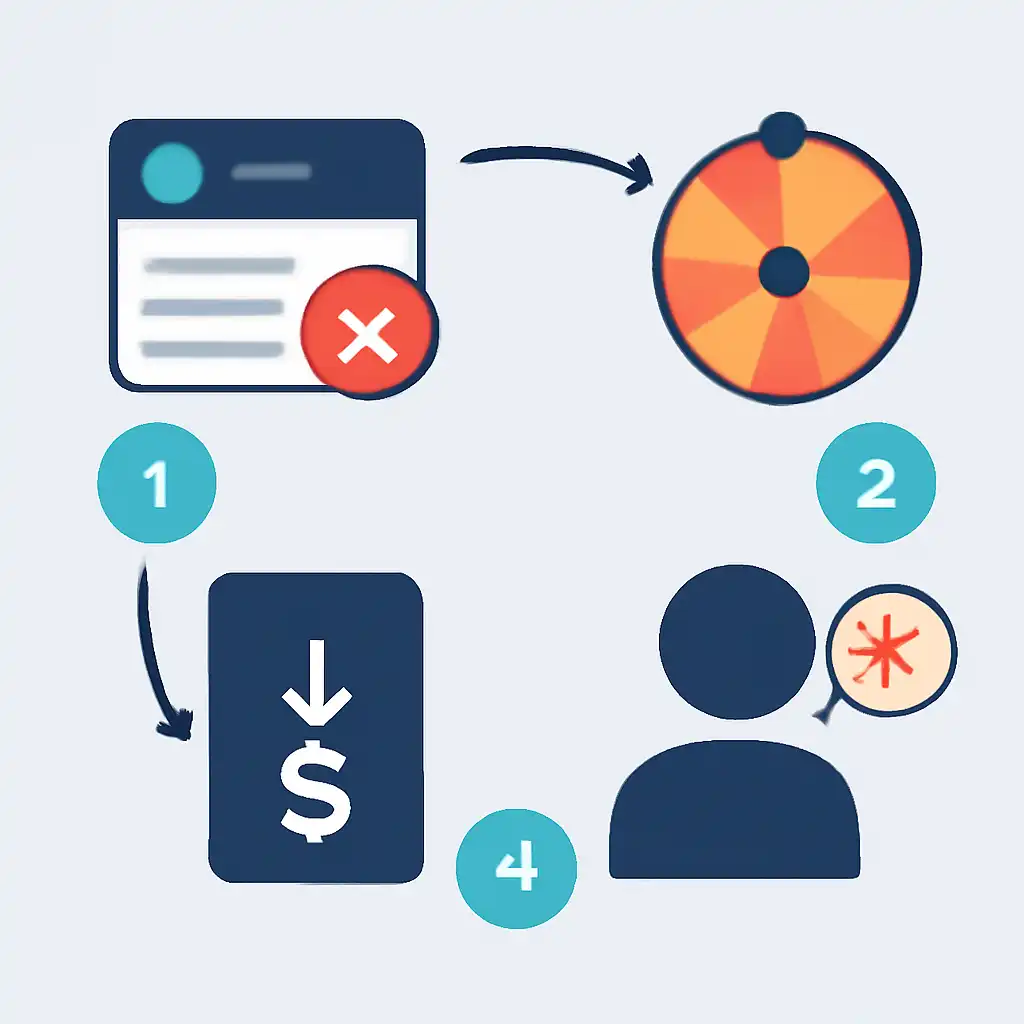
A financial loss activates the brain's threat-response system in the same region that processes physical danger. The discomfort of an unresolved loss feels urgent, and the mind generates a solution: win the money back. This creates a goal-state ("I need ₹300 to break even") that overrides the original entertainment goal ("I planned to spend ₹300 on fun"). Once that shift happens, every spin is evaluated against the recovery target rather than against your original plan. Winning ₹50 no longer feels good, it is just ₹250 short of the target. This keeps the session going past any rational stopping point.
In the Indian context, this loop is intensified by social loss aversion. Losing money that could have paid a month's mobile recharge, a restaurant dinner, or a portion of an EMI feels qualitatively worse than the same loss in abstract terms, which makes the recovery drive more emotionally powerful.
The RNG reality gap
Every spin on a certified spin game at 777-spin.com is statistically independent. The RNG produces outcomes with no reference to previous results, not to the last spin, not to the last 100 spins, and not to your account's loss history. If you lost ₹200 across 40 spins, the 41st spin does not have a higher probability of paying out. The "due win" belief is a cognitive error called the gambler's fallacy.
It is the engine that keeps the chasing loop running because it provides a seemingly rational justification for continuing: "I've been losing, so mathematically a win must be coming." On a spin game with a certified RNG, that sentence is simply false, and acting on it is costly.
Compare this to a skill-based game such as rummy or chess, where prior rounds genuinely provide information about patterns or opponent tendencies. In those games, "I've been losing, let me adjust my strategy" is valid reasoning. In a spin game, there is no strategy adjustment that changes the next outcome, only bankroll management and session discipline affect your long-term experience.
The bankroll compression trap
Chasing with a depleted bankroll is mathematically counter-productive. Suppose you started with ₹500, lost ₹350, and now have ₹150. To recover your full ₹350 loss on a spin game with a standard 95% RTP (return to player), you would need to run at significantly above-average variance in your favour, exactly when your reduced stake limits your potential upside per winning spin. A ₹150 bankroll at ₹10 per spin gives you roughly 15 spins; at ₹50 per spin (escalated to recover faster) it gives you only 3 spins.
You have tripled your per-spin risk without changing the RTP percentage, which means you are three times more likely to bust completely before a recovery spin lands.
The numbers make this concrete: at 95% RTP with ₹10 spins, your expected loss per 100 spins is ₹50. At ₹50 spins, your expected loss per 20 spins (same total of ₹1,000 wagered) is still ₹50, but your variance is much higher, meaning the range of outcomes is wider and you are more likely to either bust quickly or hit a large single win. Chasing players are counting on that variance to land in their favour while ignoring that it is equally likely to go against them.
The re-deposit acceleration pattern
Each re-deposit after a loss that was caused by chasing increases the emotional stakes. The player now has more to lose and a larger recovery target, which intensifies the same psychological loop. A session that starts at ₹500 and involves two re-deposits of ₹500 each via PhonePe has moved to a ₹1,500 at-risk total, but the player's frame has shifted: they now need to win back ₹1,000 in losses, not just enjoy ₹500 of entertainment.
Sessions that begin with chasing and involve multiple re-deposits account for a disproportionate share of total session losses globally, which is why single-session deposit limits are the most effective structural intervention available on any responsible spin game platform.
Chasing Losses Step by Step
This section gives you a concrete, step-by-step protocol to follow the moment you detect chasing behaviour in a spin game session on 777-spin.com. These steps are ordered by urgency, follow them in sequence, not selectively.
- Stop spinning immediately. Do not finish the current "run," wait for a bonus round to complete, or tell yourself you will stop after the next big win. Close the spin interface the moment you identify that you are spinning to recover, not to play. On mobile, this means exiting the game screen entirely, not just minimising it.
- Disconnect from your UPI app for 10 minutes. Turn off mobile data or move your phone to another room. Because PhonePe, GPay, and BHIM make reloading so fast, physical distance from your device is a more reliable barrier than willpower. Ten minutes of friction is usually enough to break the immediate re-deposit impulse.
- Record the session result honestly. Open a notes app, Google Keep, a WhatsApp message to yourself, or a simple paper note, and write down: session start balance, current balance, the point at which you decided to keep going past your original plan, and how you felt when you made that decision. Writing it externalises the loss and interrupts the internal justification narrative that keeps the loop running.
- Wait 24 hours before your next session. A minimum 24-hour gap after a session that involved chasing is the single most evidence-backed behavioural intervention available without professional support. It allows the stress response associated with the loss to fully clear and lets you enter the next spin game session with a reset baseline rather than a residual recovery goal.
- Set a new session budget from disposable income only. Before your next session, determine the amount you can afford to lose entirely without any financial impact on rent, bills, groceries, EMIs, or savings. For most players in India, this is a specific monthly entertainment allocation, treat it the same way you would a cinema ticket: money spent for the experience, not an investment expecting a return.
- Activate the loss limit tool on 777-spin.com. Log in, go to Responsible Gaming settings, and set a session loss limit equal to your new session budget. Confirm it before opening any game. A ₹300 session budget means a ₹300 session loss limit entered in the tool, not a mental note, not an estimate. This means the platform enforces your limit automatically, removing the decision from an emotionally vulnerable moment mid-session.
- Define your exit trigger in advance. Before your first spin of the new session, write down two numbers: a loss floor ("I stop if my balance drops to ₹X") and a time ceiling ("I stop after Y minutes regardless of balance"). For a ₹300 budget, a reasonable loss floor is ₹100 remaining; a reasonable time ceiling for an evening session is 45 minutes. Having a pre-committed written trigger consistently outperforms in-session willpower decisions.
- If you feel the urge to chase again mid-session, use the self-exclusion tool immediately. 777-spin.com provides a temporary self-exclusion option in Responsible Gaming settings. A 24-hour or 7-day self-exclusion is a practical, non-permanent circuit breaker, not a permanent account closure, and it is specifically designed to work when willpower alone does not. Activating it is a sign of self-awareness, not failure.
Comparing these steps to alternatives
Some players try to manage chasing by switching to lower-stake tables rather than stopping entirely. This is less effective than a full stop because it keeps the recovery goal active while slowing the pace, the session extends, total time at risk increases, and the emotional loop continues running. A full stop followed by the 24-hour gap is consistently more protective than stake reduction as a mid-session intervention.
Others attempt to "balance out" a chasing session by switching game types, moving from spin game to a card game, for example. This does not reset the recovery mindset; it relocates it. The ₹300 loss target follows the player across game types because it is a financial goal, not a game-specific one. The only reliable reset is time away from all real-money gaming.
When to seek additional support
If chasing losses has become a recurring pattern across multiple sessions, if you find yourself on step one of this protocol more than once per week, contact the iCall helpline run by TISS (Tata Institute of Social Sciences): 9152987821, available Monday to Saturday, 8 AM to 10 PM IST. For 24/7 automated chat support (live agents 9 AM to 9 PM IST), the Vandrevala Foundation helpline is available at 1860-2662-345. Spin games at 777-spin.com are designed for entertainment within a set budget; any session where recovery drives your decisions is a session worth pausing entirely.